Water damage in Brookhaven ranges from slow leaks to sewage backups. RapidRestore24 handles water damage for Brookhaven homes and businesses with extraction and drying, and we answer our phone 24/7.
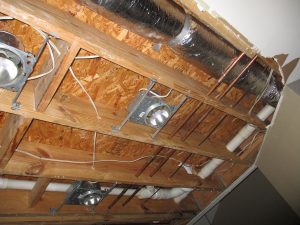
Brookhaven is roughly half an hour from our Marietta base. It has a characteristic that produces a very specific kind of water loss: an enormous amount of new and heavily renovated housing standing on ground served by some of the oldest infrastructure in the metro. New pipes upstairs, old pipes underneath.
New construction, old ground
Brookhaven has seen sustained teardown and rebuild for well over a decade. Streets that were 1940s and 1950s brick ranches now hold a mix: original cottages, houses gutted and extended, and new builds on old lots.
That produces failures people do not expect from a newer house. The most common we see:
- Connections rather than pipe. New plumbing rarely fails along its length. It fails at joints, at push-fit fittings, at braided supply connectors under sinks and toilets, and at appliance hookups. A connection that was not quite right when it went in can hold for two or three years before it lets go.
- Second-floor wet rooms. New and renovated houses put laundry rooms, primary bathrooms and sometimes water heaters upstairs. A failure there takes water down through the floor assembly, into the ceiling below, inside wall cavities, and into the lower level. By the time a stain shows on a ceiling, three levels are wet.
- Tight building envelopes. A modern house is sealed far better than the cottage it replaced, which is excellent for energy and unforgiving of moisture. Where an old leaky house dried itself out through sheer air exchange, a tight one holds the water in the assembly until something removes it mechanically.
- Old pipe still in the ground. A renovation stops at the property line. The lateral running out to the main is frequently original, and often clay or cast iron.
Sewage backups, and why Brookhaven gets them
Brookhaven sits in DeKalb County, which has been under a Clean Water Act consent decree with the EPA and the Department of Justice since 2011, subsequently modified. The county has since notified the EPA that it will miss the 2027 deadline. A large proportion of the system sits in categories carrying no fixed repair deadline at all.
Combine that with original clay and cast iron laterals under mature tree cover — roots find clay joints. A partially blocked lateral backs up into the lowest fixture in the house — and sewage backups here are an ongoing exposure rather than a freak event.
It matters enormously which kind of water you have. A clean-water loss is a drying problem: extract, run equipment, most materials stay. A sewage backup is a Category 3 loss, and porous materials that have been in contact with it are not dried and kept. Carpet, pad, insulation and affected drywall come out. The cavity is cleaned and treated, not merely dried. If anyone offers to dry a sewage backup in place and leave the materials, that is not a cost saving. It is worth knowing before you are standing in a wet basement being reassured.
The remaining older stock
Where original mid-century houses survive — and plenty do. The failure modes are the ones that go with them: galvanized supply lines corroding closed from the inside and splitting, cast iron drains weeping into crawlspaces for months before anything is visible, and original bathrooms where a failed shower pan or wax ring has been wetting subfloor quietly for years. These are found by smell or by a floor that flexes, not by water. That means the damage is well developed before anyone calls.
Water from outside
The ground drains toward Nancy Creek and the north fork of Peachtree Creek, and low-lying parcels take surface water in heavy summer rain. Surface water entering from outside is flood, excluded from every standard homeowners policy written in Georgia, while rain entering through a roof opened by wind in the same storm is generally covered. The heavy hardwood canopy is how the second one happens: a limb through roof decking opens the structure. Drying has to begin under a temporary cover rather than waiting on the roofing schedule.
How we work a Brookhaven job
Establish the category of water first, because it determines everything after it. Stop the source, then map the true extent with meters and thermal imaging before anything is removed — which matters particularly in newer sealed construction, where water sits in the assembly with very little to show on the surface. Next come containment, extraction and removal of what cannot be kept. Then we size drying equipment to the space and run it to a documented dry standard, with daily monitoring. We also photograph and log everything, including crawlspace and lateral conditions where relevant.
Where moisture has been present long enough for mold to establish, that becomes a contained remediation with the source corrected first — otherwise it returns.
Brookhaven jobs we handle
Sewage and drain backups, water damage and structural drying, supply line and appliance failures, upper-floor and multi-level losses, burst and frozen pipes, basement flooding and seepage, crawlspace moisture and mold remediation, and fire and smoke damage — around Brookhaven Heights, Ashford Park, Historic Brookhaven, Lynwood Park and the Dresden Drive corridor.
We also work in Dunwoody and Decatur, and across the rest of metro Atlanta.
Based in Marietta, GA 30067 — 404-445-4561, answered 24 hours a day — or send us the details. Photos from jobs we have done.
Water damage in Brookhaven: why speed matters
The EPA advises drying wet materials within 24 to 48 hours to help prevent mold. So water damage in a Brookhaven home should be dealt with quickly. Related: Sewage backup cleanup, all restoration services and contact us. Local resource: EPA mold and moisture guide.